

How much actually changes once a training session is over? This is a good question for all companies, especially HR departments, which are responsible not only for organising workshops but also for measuring their impact.
In my experience, long training sessions rarely lead to lasting change. Someone shows up, speaks about a topic, everyone in the room agrees, and then everything stays the same. Most of the time, this is a waste of energy and resources, although there are exceptions. And there is a reason why this happens. It is not because the training was bad or because employees were unwilling to learn, but because knowing something and changing the way we think and behave are two very different things.
Lasting change goes deeper than behaviour
If you are a business owner, head of department or CEO, I have a question for you: How do your people think? Have you observed this, and what results have you seen as a consequence of their way of thinking? Thinking is shaped by values and beliefs, so if you address those collectively, you will probably achieve better results than you might expect.
Think of organisational results as the tip of an iceberg. Beneath the surface sit the behaviours that produce those results, and deeper still, the thinking, values and beliefs that drive those behaviours.
If we want lasting change, we need to work on what’s happening beneath the surface, not just what we can see.
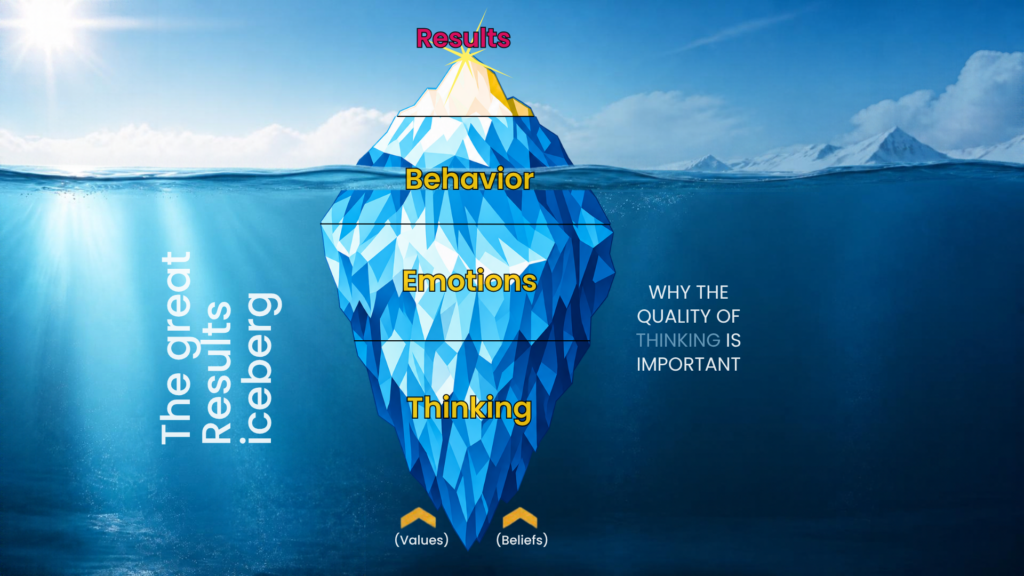
Let me give you an example. Let’s say you have a problem with miscommunication between departments, creating all sorts of noise in the process. You organise a workshop on communication skills and how to share feedback. Everyone attends, everyone understands the topic, and everyone agrees that things need to change. But at the first sign of trouble, the old behaviours surface again. Why do you think that happens?
It is because a thematic workshop does not necessarily address the way people think. For that to happen, micro-training needs to take place in real time, at an individual level, where people can learn how to approach issues as they arise. There is underlying psychology to this. Knowledge is one part of the equation, but what good is knowledge if it does not change anything?
Let me give you a more detailed example. I once worked with a team in which one person was particularly problematic when it came to pressure, and I do not mean unhealthy pressure. Whenever someone asked this person to get something done, he would immediately go into defence mode and start complaining to everyone on the team. His colleagues described the behaviour as draining because he was not only failing to get the work done, but also dragging down the people who were getting it done.
In these situations you cannot change this behaviour through a workshop, no matter how long or specific it is. The real problem is not a lack of knowledge about how to behave. It is the way the person thinks about the situation in the first place. Until that changes, the same reactions are likely to keep showing up, regardless of how much training the person has attended.
Why traditional training often falls short
Traditional training tends to separate learning from the reality in which employees are expected to apply it. People leave the classroom with new information, but once they return to their everyday responsibilities, the pressure of deadlines, established routines and competing priorities takes over.
Behavioural change requires repetition, reflection and application. It also requires employees to understand not only what they should do differently, but why their current approach needs to change. If someone believes that asking for help demonstrates weakness, a workshop on teamwork may not be enough. If a manager believes that being in control means making every decision, a session on delegation might introduce a useful concept without changing how they lead.
That is why micro-training in real time can be much more effective. It addresses the core: the human being who needs to change their way of thinking, for their own good, but also for the good of their teammates, the people they lead and the organisation as a whole.
Individual sessions are also private, giving people the freedom to ask questions and share whatever comes to mind. That freedom is not always possible in an open workshop dedicated to a specific topic. The same level of intimacy and vulnerability is not present there, nor should it be, because many behavioural battles have a background that does not need to be shared with everyone. But that does not mean they should be ignored. They can still be addressed, understood and learned from.
The business becomes the classroom
When learning is connected to real work, the organisation itself becomes the classroom.
A difficult conversation becomes an opportunity to practise listening. A missed deadline becomes a chance to examine how responsibility is shared. A disagreement between departments becomes an opportunity to understand different perspectives and improve collaboration.
Everyday situations provide the context, employees participate in the learning, and the workplace becomes the place where new behaviours are tested. This approach also changes the role of training. Of course, micro-training is not simply about delivering smaller pieces of information. Its value lies in connecting a specific learning objective to a real situation, giving people an opportunity to practise and returning to the lesson often enough for a different response to become more natural. Without application and reflection, even micro-training can become another activity that employees complete without changing how they work.
Organisations do not change when employees simply learn something new. They change when employees start thinking differently, acting differently and bringing those differences into the way they work together. And if you are in need of changing the bottom of the iceberg, I would be more than happy to meet you and share how it can change your organisation.