

Every organisation has an unseen layer that influences its success far more than most people realise. It exists without exception, yet it is rarely understood and even more rarely addressed properly.
Let me start by giving you an example.
A few years ago, I was asked to help a company address its poor reputation and the wave of negative word-of-mouth surrounding it. This was before COVID, when the engineering market was booming and attracting top talent depended heavily on having a strong employer brand. The leadership team could not understand why hiring had become so difficult.
When I looked beneath the surface, the answer became obvious. The problem was not the people. It was leadership. Poor leadership had permeated every level of the organisation, creating a toxic environment where projects were still being delivered, but people were not thriving. New hires left within months, while those who stayed became the company’s harshest critics.
What appeared to be a recruitment problem was actually a human systems problem. And that unseen system is the focus of this article.
The underlying issue
Every organisation has both a visible and an unseen side. The easiest way to understand it is to think about the feeling you get when you walk into a room and instantly sense that something is off. No one has to say a word, yet you can feel the tension, the discomfort or the lack of trust.
That invisible energy is part of the organisation’s human system. It shapes behaviours, relationships and ultimately performance, even though it cannot be seen on an organisational chart or measured in a report. And more often than not, the greatest influence on that system comes from the people at the top, whether that is the executive leadership team or the business owner. Energy and example are set from above.
The way company values are established and implemented creates an organisation that truly embodies them. That is why it is rather frustrating that so many companies treat their values as little more than PR statements displayed on a wall. If those values are not genuinely lived and embedded throughout the organisation, there is little point in having them at all.
A useful way to understand this is through the metaphor of an iceberg (see illustration below). What we see in an organisation is results and observable behaviour. This is only a small part of what is actually driving performance. Beneath the surface sit the less visible human factors: emotions, thinking, beliefs and values. These deeper layers continually influence what eventually becomes visible above the surface.
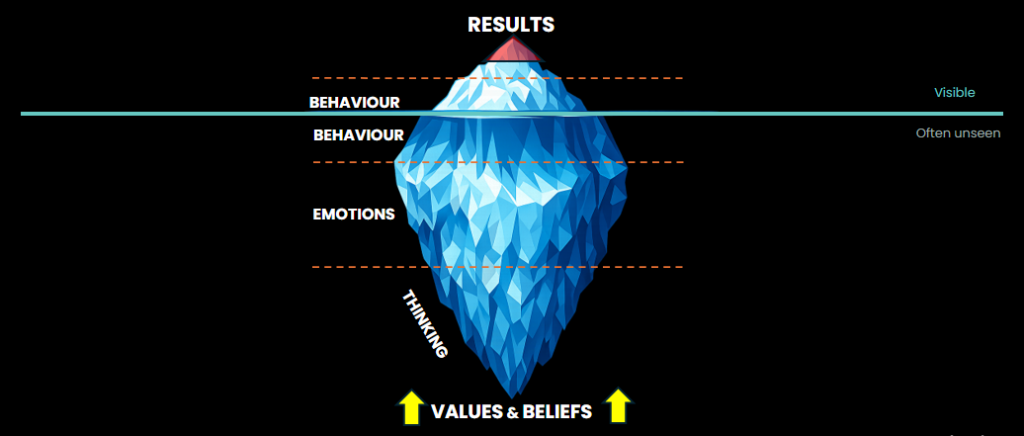 Inspired by David Rock’s Quiet Leadership and related work in cognitive psychology and systems thinking. Adapted through the ACE framework by TC Gill.
So, let’s look beneath the surface at the human factors that have such a profound influence on both organisational and financial performance.
The question, then, is how to address the unseen, in this case the thinking and emotions. The most straightforward way is to examine how the system is led, identifying the gaps in the values and beliefs of the people working within it. Coaching these individuals often means organisations must confront uncomfortable truths about the way they are managed and led. However, that is a small price to pay compared with the consequences of allowing those issues to persist unchecked and eventually grow into a costly organisational failure.
It may seem ridiculous to some that an organisation needs to address behaviour and emotions, but these are the primary drivers of people, and people, in turn, drive ideas, execution, and organisational success. The layer you cannot see is both the most important and the most challenging to address.
How do you align people around your goals? How do you motivate them? How do you make the impossible possible? These are questions that can be addressed and resolved. In fact, they were the motivation behind creating the ACE model. My clients were almost always trying to solve the unseen part of the organisation, and they needed a solution that was adaptable, scalable, and could be implemented regardless of the industry.
However you choose to address these challenges, always remember that you need a method capable of feeding valuable feedback loops back to upper management, enabling leaders to continuously improve what is not working.
The resolution
I began this article with a practical example from my own experience, and I would like to briefly share the work we did to give you a glimpse of how these challenges can be resolved.
The first step was gathering insights from the upper management team about the organisation’s poor reputation and everything they believed had contributed to it. I then asked them to identify the leaders who should be first in line for development, as well as those who were best positioned to create the feedback loops needed between the organisation and senior leadership. My role was to collect those insights, coach the leaders, and ensure that honest feedback was communicated safely and constructively to upper management.
The coaching process lasted around six months. Gradually, the negative atmosphere began to subside, making way for a more collaborative, people-centred culture. For that transformation to happen, upper management had to be willing to hear uncomfortable truths and, more importantly, act on them. They did exactly that. As a result, they began building a leadership culture that embodied the organisation’s values in every aspect of its work, including the way leaders communicated, made decisions, and supported their teams.
If you are a business owner, CEO or senior leader in the middle of a big transformation, having people in burnout,or dealing with leadership challenges, I would love to tell you more about how ACE can be implemented to your organisation. Let’s talk!